
WhatsApp’s Oct 2026 pricing change will require UAE clinics to change communication policies
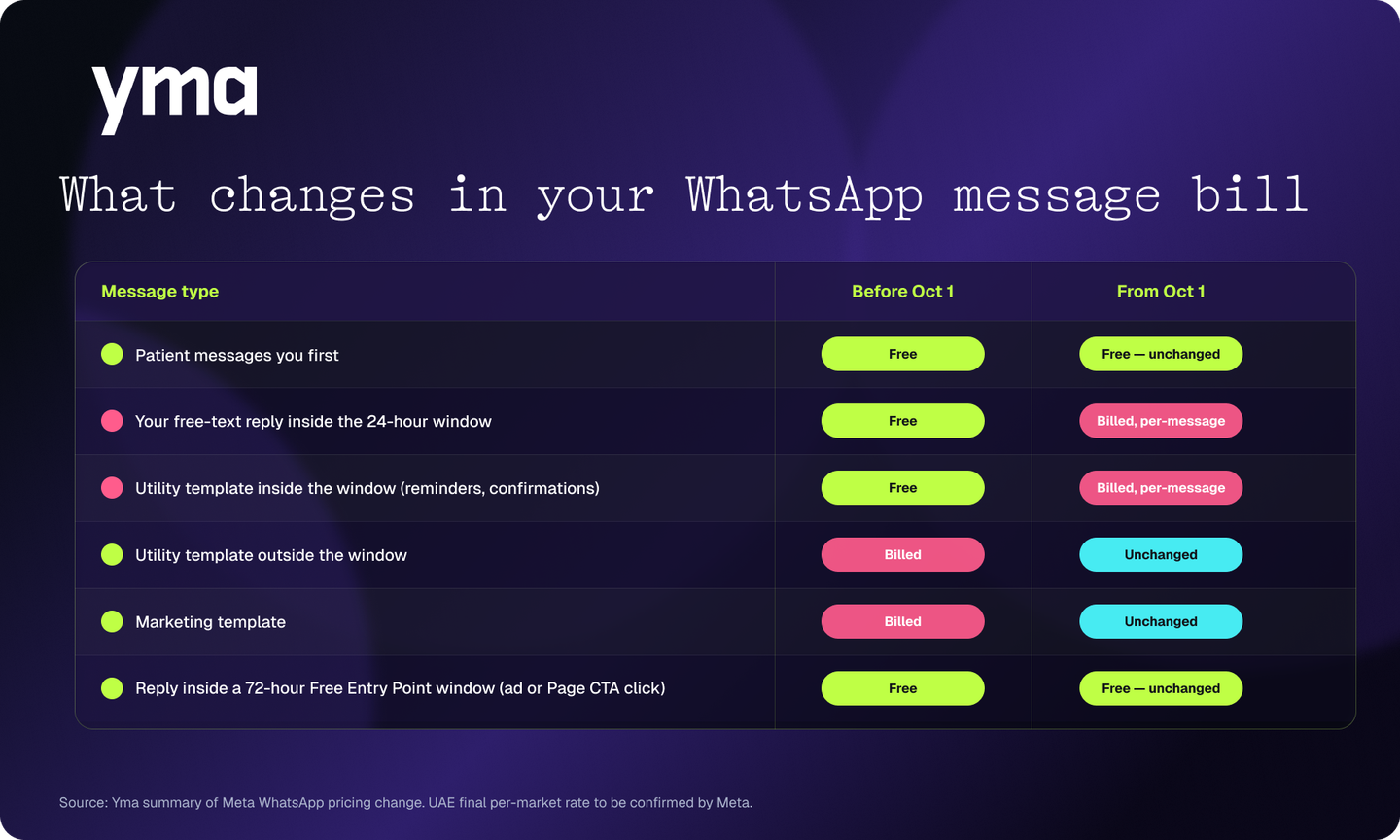
From October 1, 2026, Meta is expected to charge for service messages on WhatsApp. Clinics with prepared workflows shall treat this as a manageable change that can also improve communication clarity.
Many clinics use WhatsApp for bookings, reminders, reschedules, follow-up questions, and routine coordination. An estimated 1million whatsapp messages is sent by UAE clinics daily, the whole market is hooked on the channel that became massively popular and a de-facto standard since Covid. A channel that once felt operationally harmless can now become a massive cost burden.
From October 1, 2026, clinics using WhatsApp for patient communication should prepare for a new cost reality. Meta is expected to start charging for service messages. These are the basic replies a clinic sends inside the 24-hour window after a patient messages first. Utility templates sent inside that same window are also expected to lose their free status. Patient messages to the clinic remain free.
Clinics should treat two pricing points with caution.
First, there is no confirmed free monthly allowance for service messages
Second, there is no stated volume discount for service messages, unlike some utility and authentication templates. A clinic sending thousands of replies should not assume the later messages become cheaper.
For the UAE, final pricing has not been confirmed, current trackers place relevant UAE utility and authentication pricing around AED 0.04–0.06 per message.
What does this mean?
The prudent move is to model the impact and design response communication policies before the kick-off date – to escape excess charges.
- Reply quality now affects cost. A clinic that answers one patient in five short messages may pay five times when one complete reply would have worked. A confirmation, address, preparation note, and payment link can be combined.
- Study and leverage the 72-hour Free Entry Point window. When a patient starts a conversation through a Click-to-WhatsApp ad or a Facebook Page WhatsApp button, and the clinic replies within 24 hours, the clinic may receive a 72-hour window in which messages remain free. This does not apply to every organic WhatsApp conversation, but it can still improve the economics of ad- and CTA-driven demand.
Two commercial controls matter:
- Clinics should check whether their WhatsApp provider passes through Meta’s rate or adds a platform margin.
- They should also identify repeatable messages that may work better as approved utility templates, especially if formed templates can dampen the cost.
While WhatsApp remains one of the most practical patient communication channels in the region, operating it in a disciplined fashion is important: clinics that run WhatsApp as an improvised inbox may find that small messages weigh heavily on their budget.
Clinics with structured WhatsApp workflows will treat this as a manageable change that can also lead to improved communication clarity.
Yma provides its clients with an embedded front-desk orchestrator that, aside from being a domain-savy and secure method to cover patient inbound-and-outbound communication, is governed by easily-set-up process.
Yma Workspace uses a human-in-the-loop model: AI drafts the message with the team reviewing it and reusing formed templates in the defined inbound and outboung communication cases. Formed drafts can be shortened, combined, routed, or turned into a template the clinic front-desk can rely to lower the impending cost burden. Learn more on https://lnk.yma.health/1qncwfdq