
Healthcare's (admin OPEX) moving beyond the clinic
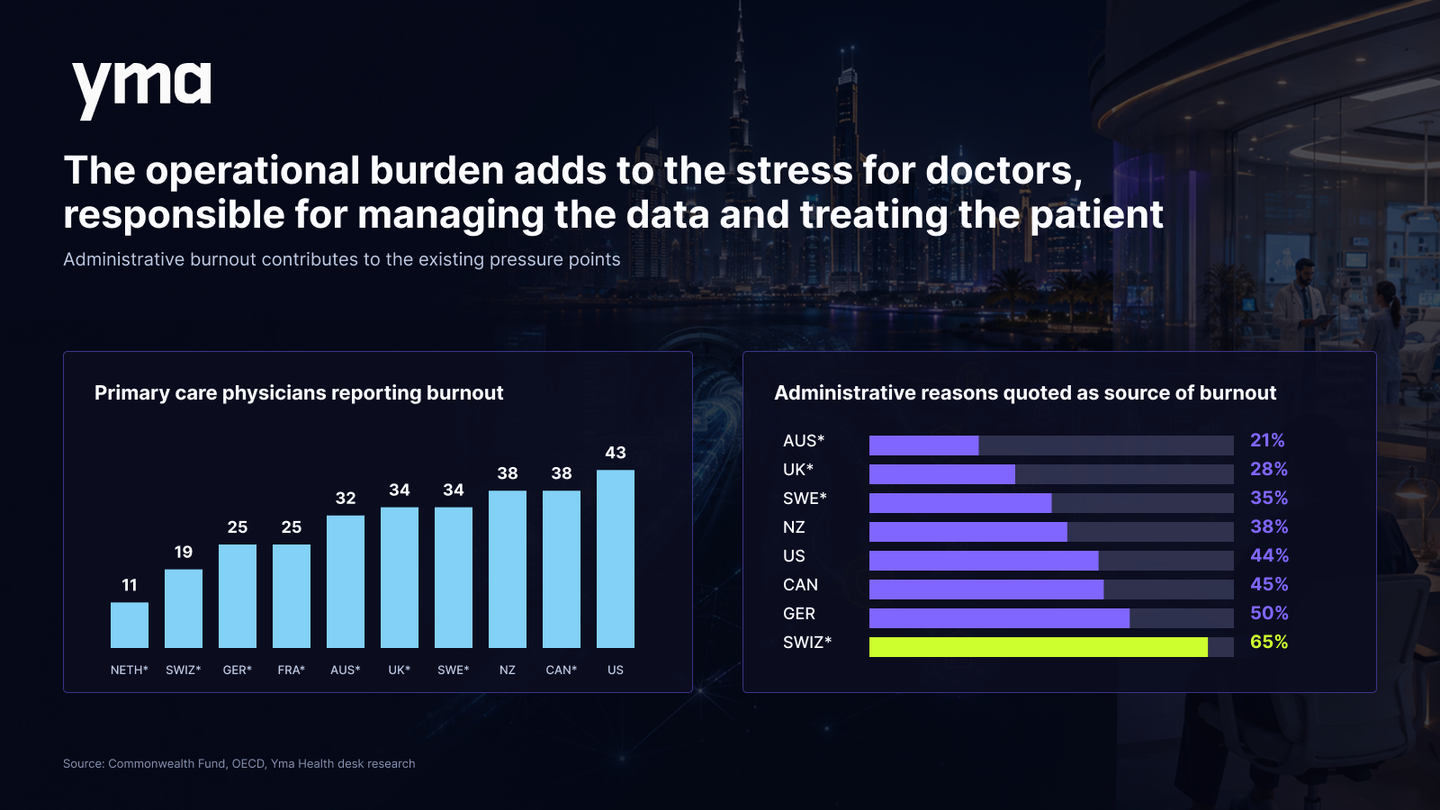
The doctors' pool thinning, triage and visit-preparation moves outside the perimeter of a clinic with the help of AI. What can go wrong?
Healthcare is facing a simple but urgent challenge today: the number of experienced doctors is under pressure, while the amount of useful health data is growing fast. More information now comes from patient portals, wearables, home tests, remote monitoring and personal health apps.
This data can be used to more accurately triage and infer when preparing for a doctor visit, yet is often neglected, rather appreciated by the “parallel world” of wellness — not properly integrated in the “healthcare part” of it.
If one looks at the workforce data, the burden of admin becomes even more pressing. In 2023, 32% of doctors across OECD countries were over 55, and in nine countries the share was 40% or higher, according to OECD Health at a Glance 2025. In the EU, an estimated 1.2 million doctors, nurses and midwives were missing in 2022 according to European Comission, while more than one-third of doctors wereover 55, according to OECD’s Health at a Glance: Europe 2024.
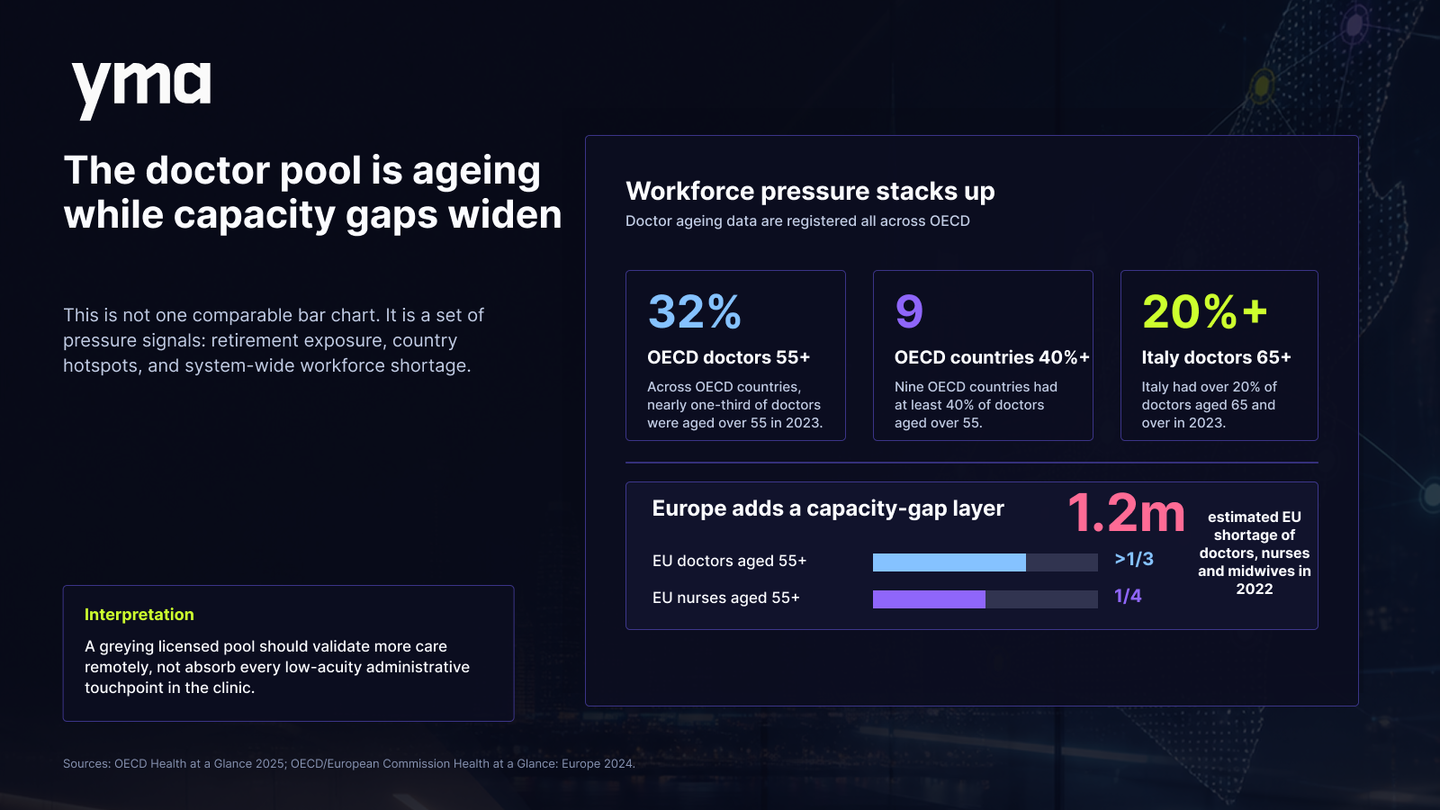
At the same time, patients are creating more health data outside the clinic. That data can be valuable, but clinical decisions still need licensed professional review. The result is a mismatch: care is becoming more distributed, while staffing, reimbursement and facilities are still built around the clinic.
This creates an opportunity to move the right parts of care closer to the patient.
With secure protocols, services such as triage, diagnostic support, remote consultations and doctor-patient communication can happen outside the clinic when an in-person visit adds limited value.
Clinics can then focus on examinations, procedures and complex care that truly require staff, equipment and physical space.
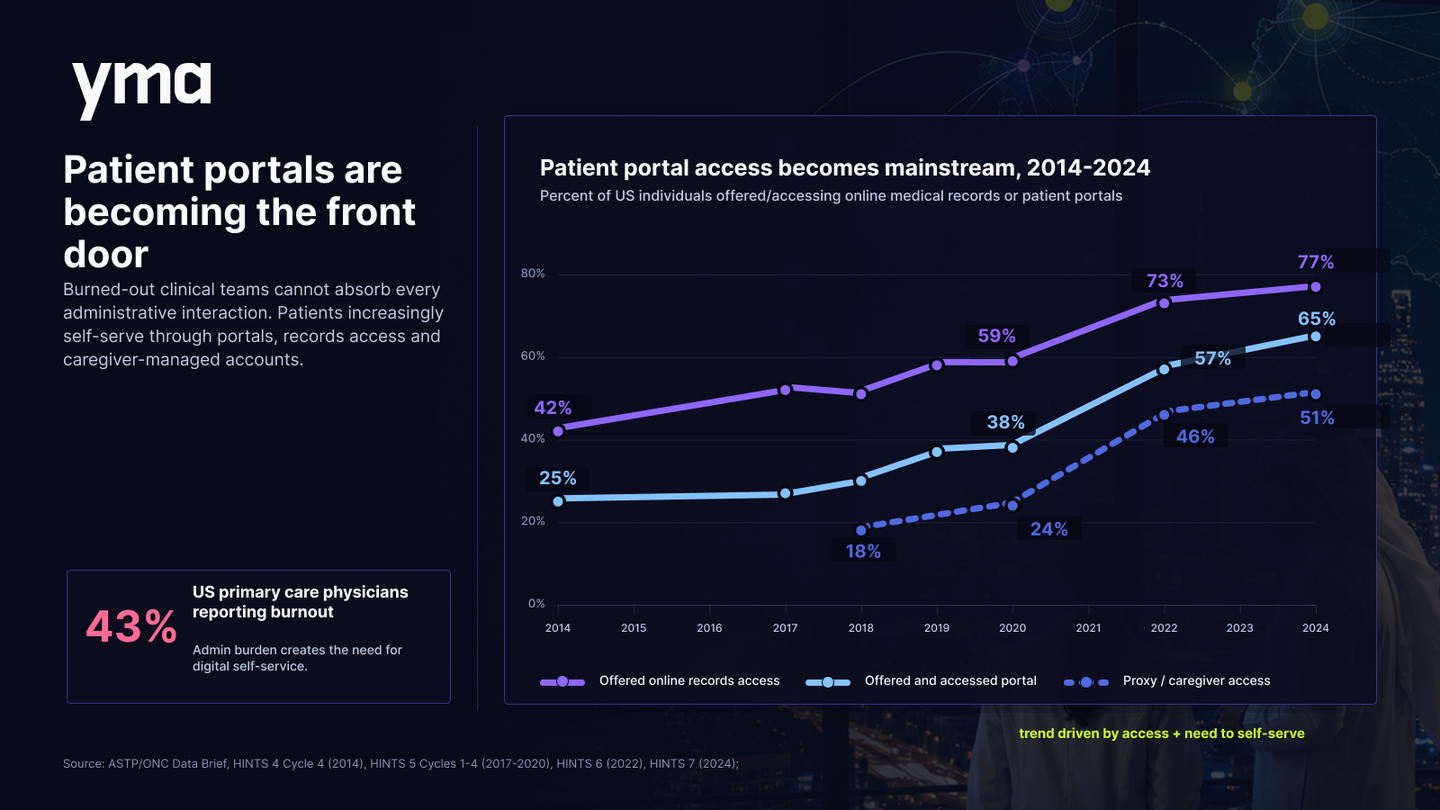
As the US healthcare market shows marked uptick of patients being able to access their EHR data, making use of the data that is preserved there requires assistance, today often coming via AI
AI can support the above mentioned shift — to free doctors by pushing the data staging and preparation (via direct communication and interpretation of signal input), but it should not become an unchecked shortcut from patient data to a clinical decision.
The OECD reports that AI is already widely used in health administration, while national-scale clinical use remains limited because of fragmented data, governance gaps, privacy and security risks, biased data and insufficient oversight (OECD, Scaling Artificial Intelligence in Health, 2026).
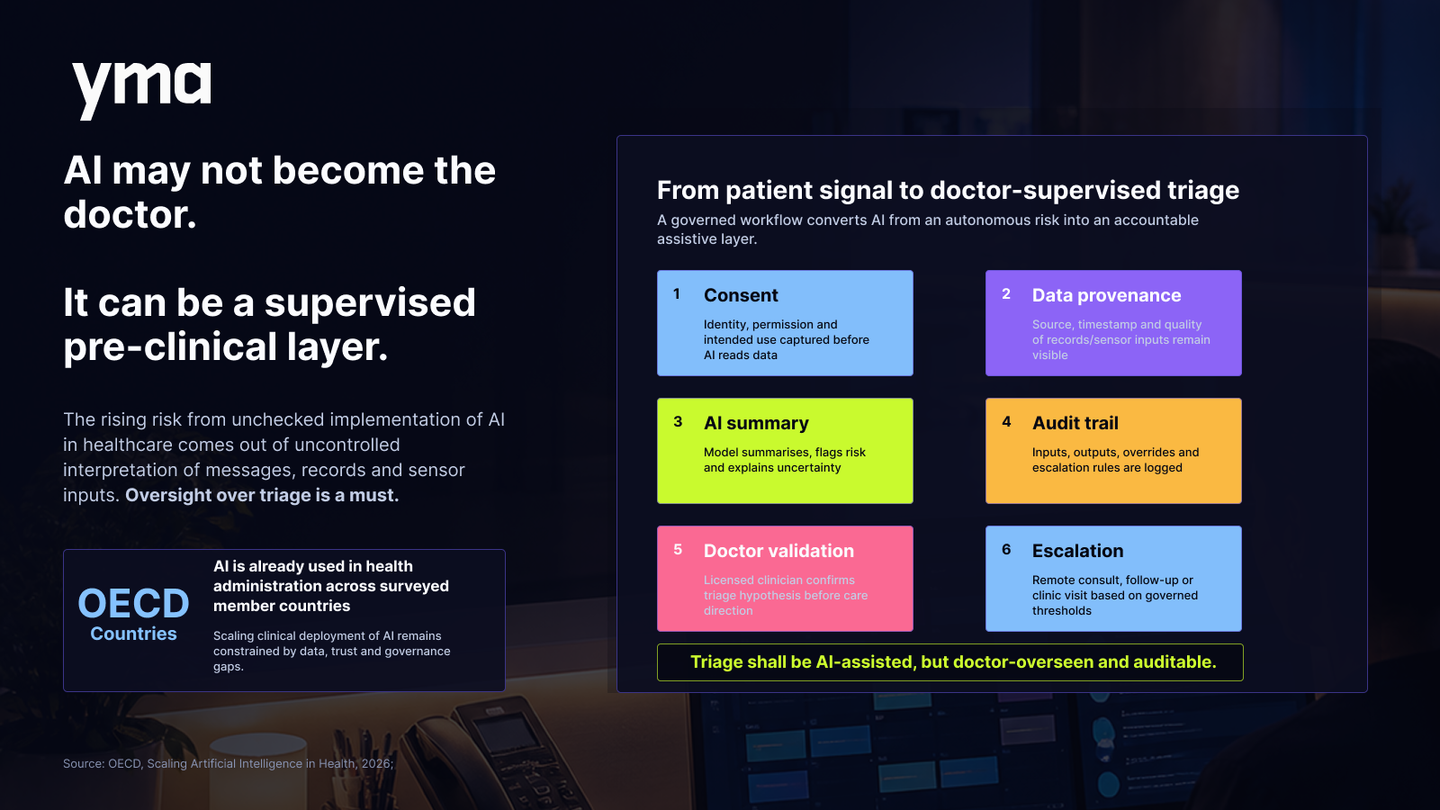
For Yma, the principle is simple: AI can help interpret symptoms, records, messages and sensor data, but triage must stay supervised. Data sources, consent, escalation rules, accountability, audit trails and doctor validation should be clear before AI influences patient routing or care advice. This has been recently covered by one of our co-founders, Sergey: spending years tinkering with models and developing Yma triage agents, he has a keen eye on the latter’ idiosyncrasies and building auditable procedures to minimize free behavior — where the last and best form of defense remains a doctor.
It comes down to the orchestration of signals generated by the system to build a trusted partner for the doctor — and not a machine that by completely stressing out the (only remaining) professional will reign unchecked.