
Can AI answer the questions patients ask about your clinic?
Yma’s individual AI Readiness Report gives clinics a provider-specific view of the public evidence available to AI-assisted search.
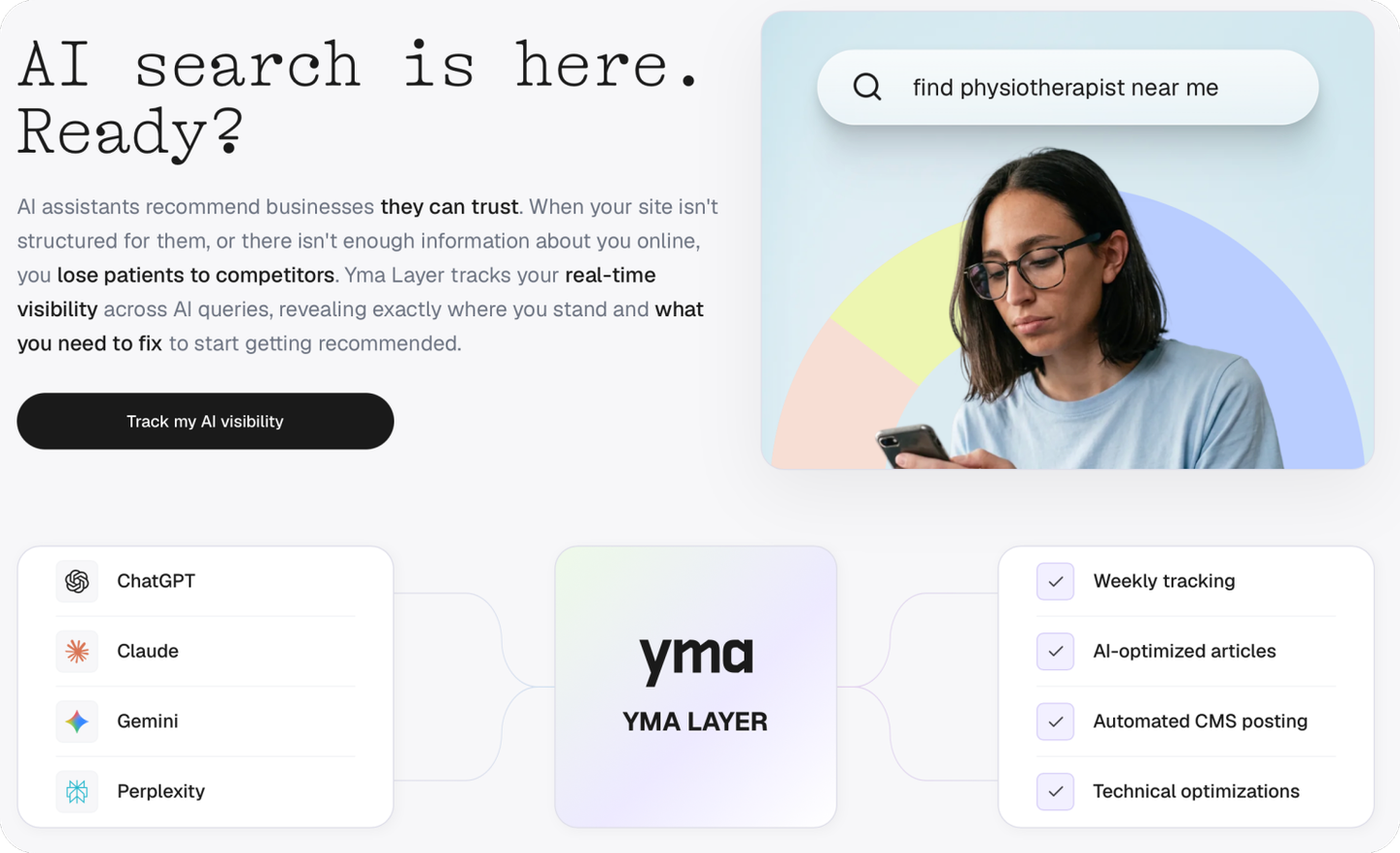
Patients increasingly ask AI systems:
Who treats this condition near me? Which doctors work at this clinic? Does it accept my insurance? What languages are supported? Is pricing available? Can I message or book now?
Those questions expose a new kind of gap.
A clinic may have a website, an active social presence and strong public reviews, but still lack the structured evidence required to answer the questions that influence patient choice. Information may exist across separate pages, directories and profiles. It may be incomplete, inconsistent or difficult to attribute. The clinic can be visible online without being fully understandable inside an AI-generated answer.
Yma can now provide anindividual AI Readiness Report(https://lnk.yma.health/sea8rmbs) to help a clinic see that problem at provider level.
What the report is designed to answer
The report creates a structured baseline around five practical questions:
1.Can an AI system identify the clinic correctly?
2.Can it explain the clinic’s doctors, services and specialties?
3.Can it find the information patients use to compare options?
4.Can it identify a reliable route for the patient to act?
5.Which gaps should the clinic address first?
This is different from a classic SEO audit.
SEO often begins with keywords, rankings, traffic and technical website performance. Those signals remain useful, but AI-assisted healthcare discovery is more answer-shaped. The issue is not only whether a page can be found. It is whether available evidence can support a complete, attributable and actionable response..
A missing doctor roster can directly weaken clinician answerability. Missing services can make treatment matching harder. Missing pricing or insurance cues can interrupt comparison. An unclear contact route can prevent a patient from acting even after the provider has been surfaced.
What a clinic receives
The report is intended to turn scattered public signals into an actionable view.
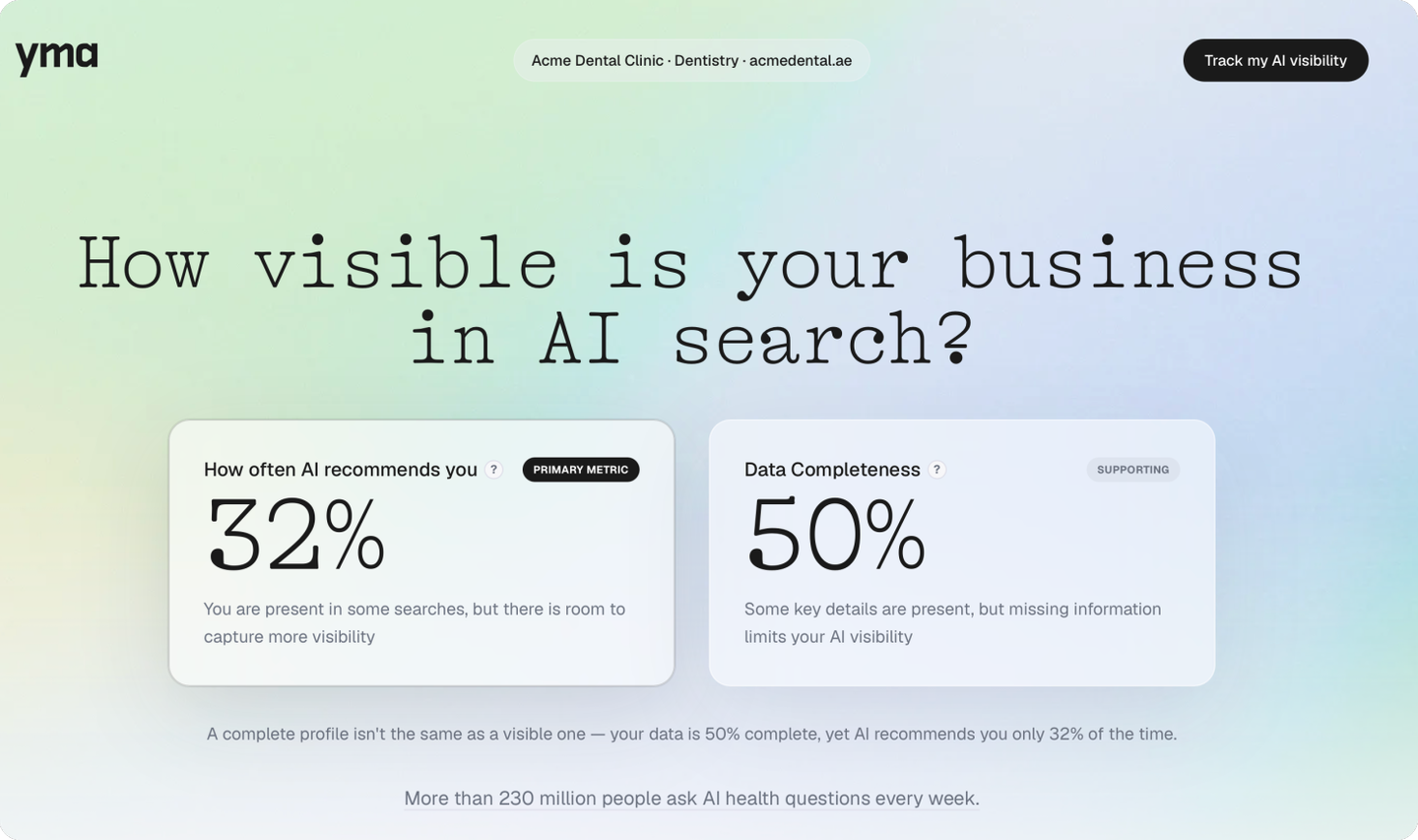
A provider-level readiness score
The score shows how much of the weighted public evidence is currently present. It is a baseline for improvement, not a probability of being recommended by an AI model.
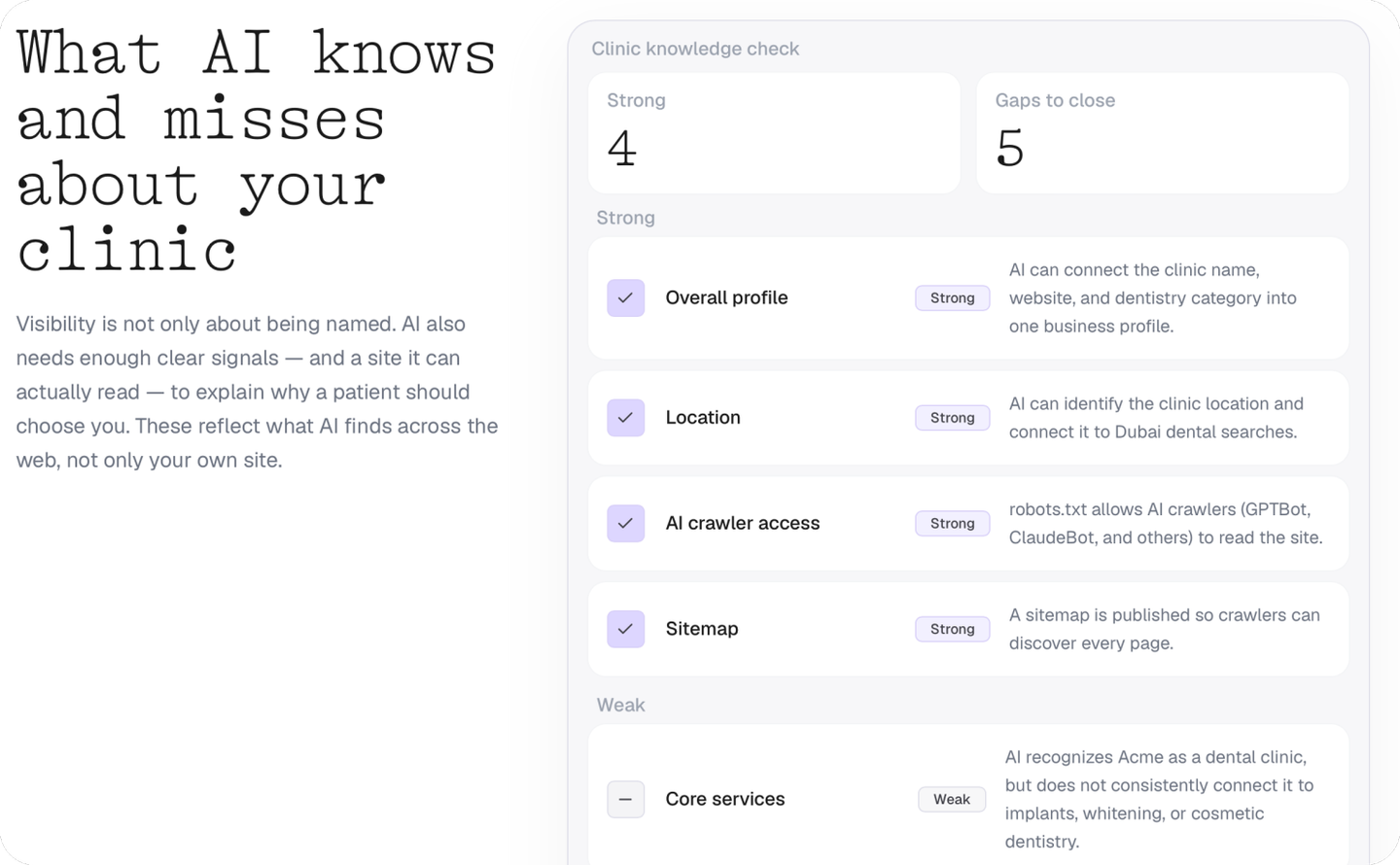
A field-by-field evidence review
The clinic can see which information was found, which fields remain incomplete and where evidence appears inconsistent or insufficient.
A market benchmark
The clinic’s position can be interpreted against the wider UAE provider sample and relevant market patterns. Benchmarking helps distinguish a clinic-specific issue from a category-wide readiness gap.
A question-oriented interpretation
The report connects fields to the patient questions they support. A doctor roster is not treated as a database checkbox; it supports questions about who performs a treatment. Pricing information supports affordability and comparison questions. Languages and direct messaging routes support access.
A prioritised improvement backlog
The final objective is action. The report identifies where structured information, website content, doctor and service detail, insurance cues, pricing, media or communication routes should be improved.
What the score does—and does not—mean
The individual AI Readiness Report measures the presence and structure of public provider evidence.
It doesnot:
- assess clinical quality or patient outcomes;
- validate the medical accuracy of every public statement;
- certify regulatory compliance;
- guarantee ranking or recommendation by ChatGPT, Claude, Gemini, Copilot, Perplexity or another system;
- claim that every AI model retrieves information in the same way;
- replace human review of sensitive healthcare communication.
AI systems can reach provider information through websites, business profiles, directories, search indexes, citations, connected sources and governed integrations. Their answers also vary by query, location, timing and model behaviour.
The report therefore focuses on the layer the clinic can control: the quality, completeness and actionability of its supporting evidence.
Why the timing matters
- OpenAI reportsthat more than230 million people ask health and wellness questions on ChatGPT each week. Its healthcare research found thatseven in ten health conversations occur outside normal clinic hours.
- West Health and Gallupfound that AI is used before and after healthcare visits—and can influence whether a patient visits a provider at all.
- In the UAE, the shift is reinforced by unusually high adoption.Microsoft’s AI Economy Instituteranked the UAE first globally for AI diffusion at the end of 2025, with64.0%of the working-age population using AI.
- The2026 Edelman Trust Barometer Special Report: Trust and Healthfound that nearlysix in ten UAE respondents use AI to manage their health, while70% are confident finding health information and making informed decisions.
For clinics, this means AI-assisted discovery should be treated as an emerging patient-access channel rather than a future marketing experiment.
Why does this matter?
A clinic adds a doctor. A service page is updated. Insurance arrangements change. A price list is published. A WhatsApp route stops working. A third-party directory keeps an old address. An AI system changes how it retrieves and cites information.
For that reason, the individual report is most useful as the beginning of a cycle:
- Observethe clinic’s current public evidence.
- Compareit with the questions patients ask and the market benchmark.
- Prioritisethe gaps that affect answerability and access.
- Improvethe source information and communication assets.
- Re-runthe assessment and review what changed.
Better discovery also creates an operational responsibility
Improving provider information is only the upstream part of the patient journey.
If stronger representation creates more calls, messages and booking attempts, the clinic must be able to handle them. After-hours response, routing, multilingual communication, escalation, reminders, follow-up and booking support determine whether the new demand becomes an appropriate next step.
The clinic therefore needs to ask two connected questions:
- Can AI-assisted search understand and represent us?
- Can our team manage the patient intent that follows?
The individual AI Readiness Report addresses the first question and helps reveal the requirements created for the second.
Request an individualAI Visibility and Readiness Reportathttps://lnk.yma.health/5sxyn5gz, or learn more aboutYma Layer.